

Matus Vavercak, the co-founder of Vita Pop, believes his fledgling brand can be the prebiotic soda that has functional benefits and is tasty, too.
Vavercak has experience in setting up drinks brands – he was one of the founders of The Gutsy Captain Company kombucha – and established Vita Pop in March last year. The Spain-based business generated €500,000 ($580,000) in sales up to the end of 2025 and is targeting €1.5m this year through its existing presence in Europe, where it sells in 15 markets.
Go deeper with GlobalData


Discover B2B Marketing That Performs
Combine business intelligence and editorial excellence to reach engaged professionals across 36 leading media platforms.
However, Vavercak is also about to launch Vita Pop in the US, the principal market for prebiotic soda and home to heavyweight brands including PepsiCo’s Poppi and Olipop.
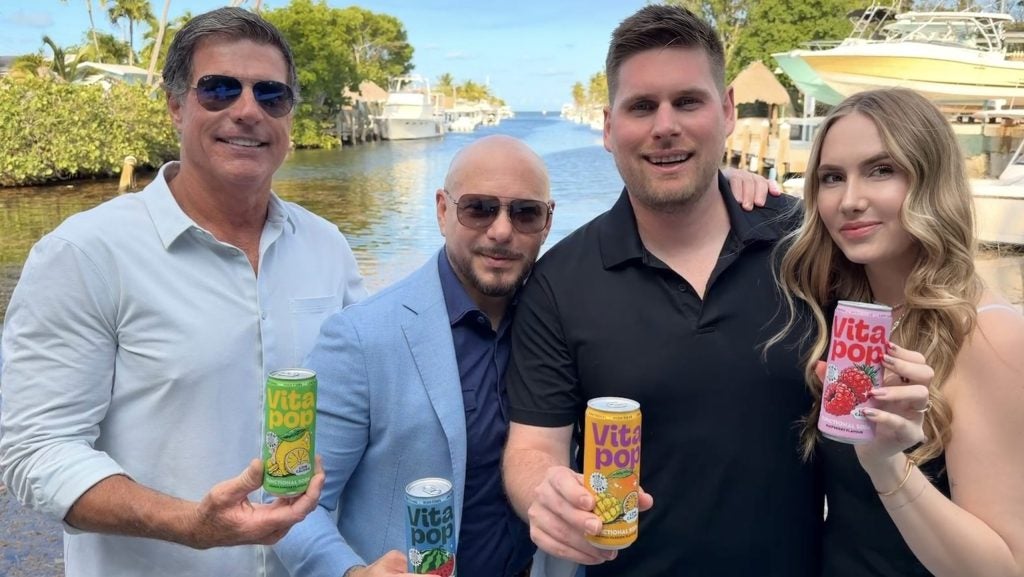
As part of those efforts, Vita Pop has attracted US singer and songwriter Pitbull as an investor and hopes to use his following to support the company’s entry into the US and its expansion in Europe.
Vavercak sat down with Just Drinks to discuss Vita Pop’s plans on both sides of the Atlantic, trying to compete with the likes of Poppi and his belief his brand can carve out a foothold with its more “mainstream” taste.
Dean Best (DB): Who is your partner in the US venture?
Matus Vavercak (MV): Our partner is Liberty Beverages. We already have production set up in the US. At the beginning, we thought we would be producing here in Europe [for the US]. However, due to everything going on now in the world, it would be a really risky decision. We already have a team set up over there. I wouldn’t like to now disclose exact names, etc. but it’s a team of industry professionals. There is a nice size of investment behind the project, so we think we will have a nice opportunity to launch and already have some retailers kind of arranged over there. The launch date should be middle-to-end of July.
DB: Which will be the first US retailers to stock your products?
MV: I spoke with our partners in the US about this because I knew this question was going to come up. We do not, unfortunately, want to disclose it yet. There are oral agreements but not yet confirmation, so we wouldn’t like to mess up something. What I can tell you is our headquarters is in Kansas City and we will be starting from the Midwest, so big retailers in that area.
DB: At what price will Vita Pop be sold in the US?
MV: The pricing depends on the retailer but it should not go over $2.49 per can, so I would say similar pricing to similar drinks in the category.
DB: Why did you want to enter the US, a market with brands like Poppi and Olipop?
MV: We definitely don’t look at ourselves and think we are going to dominate the category but we see there is a possibility for something different. Why do we believe there is a space for Vita Pop? Vita Pop really tastes like a good soda. I like Poppi, I like Olipop. However, we see that those brands in the US are really focusing on an extremely low-calorie profile, which means very low sugar and very high stevia. With stevia, it’s very tricky. If you don’t have a good combination of sugar and stevia, you can have a lot of after-taste.
Vita Pop is a taste-first, function-second, kind of approach. We have five grams of prebiotic fibre, we are low in calories, we are all-natural. However – and we are not hiding this – we have a little bit more sugar. It’s double the amount of Poppi and Olipop but still 70% of the sugar level of Coke and Fanta. What this delivers is a really different, mainstream taste profile.
From the numbers we have seen in the prebiotic soda category, it’s growing greatly. However, it’s still maybe four or five per cent of the total soda category. There is still a huge amount of people who do not buy for certain reasons and we believe with this mainstream taste profile we can approach those guys.
DB: Vita Pop contains five grams of fibre. Poppi tends to have three grams and five grams of total sugars. What are the total sugars in Vita Pop?
MV: We have ten.
DB: Are you concerned some consumers might think twice about buying Vita Pop?
MV: Absolutely and, definitely, there will be consumers like that. We will never sell to everyone. We are not hiding anything. We are very straightforward with this. However, we say try Poppi and try us and then you will see a huge difference in the taste. Of course, there will be people comparing five or ten [grams of sugar] but, if people look at the big picture, it’s still ten versus 40 with Fanta or Sprite or Coke, you know?
DB: How would you like the US business to look in 12 months’ time?
MV: We want to build a brand around good taste and functionality. We definitely want to have national distribution, so we have really big goals with the team over there. Let’s say within the first 24 months, entering Walmart, Kroger and the big accounts. However, we see Vita Pop also playing in different categories. That is the main differentiation factor in the strategy. I wouldn’t like to specify now the categories —
DB: You guessed my next question.
MV: We can see what is happening now in the soda world, whether it’s protein, creatine, electrolytes and whatever. We definitely see Vita Pop entering more of these categories. The one absolutely main thing for us is the taste-first factor. If we are not able, for example, to create really good tasting protein, we would never launch it.
DB: What are your main markets in Europe?
MV: The top five markets for us are Spain as our home market, Belgium, Netherlands, Czech Republic and Slovakia because that’s where we as the founders are from, so a lot of connection there, and also some of the Scandinavian markets like Denmark.
DB: Is the brand principally on sale through supermarket chains?
MV: It is. Supermarket chains, I would also say pharmacies, so in central Europe like DM Drogerie Markt. That has been a great channel for us and convenient stores.
DB: Where are the two new markets you’re entering in Europe?
MV: France and Germany.
DB: How would you describe the category in those two markets?
MV: Not only in France and Germany, but I would also say in the majority of the markets [in Europe], it’s still early. It’s a lot about convincing the buyer, showing them the US case study. That’s the biggest kind of challenge, not only for Vita Pop but for all in the category. Here in Europe, we are slightly behind [the US]. Sometimes it’s really hard to convince the buyer and explain this has really exploded in the US and we should do something about it.
DB: What are buyers in Europe saying about prebiotic soda?
MV: I would say the first question is: what is prebiotic? They have heard about probiotic. Now it’s about explaining to them that one small letter actually means a very big difference. When they get what it actually is, that it’s actually fibre, which has been here for forever, is in so many other foods and has just not been kind of explored, they understand it.
Then it’s more about the basic questions. “Why you? Why do you believe that you can sell soda?” Pricing. Soda here is really cheap. It’s below €1. We are selling Vita Pop €1.79/€1.99, so that is the main question. “Why do you believe people will buy soda for double of the price, even if they understand the functionality?” So, we really need to convince them that this is something different – functional but also different in taste, different in the way it appears.
In the majority of the markets [in Europe], it’s still early. It’s a lot about convincing the buyer
We believe Vita Pop is a soda for Gen Z, for the new generation, so that’s why [we use] bright colours, different flavour profiles, like watermelon or raspberries. In the office, we like to speak about Monster and little kids. You know, you see them on the street drinking it. You ask them why and the majority of them don’t even know it’s energy, you know? They drink it because it’s cool, it has different flavours. It’s kind of what we see we need to be, although in a healthier sense, of course.
DB: Why do you think consumers would pay nearly double for Vita Pop than for conventional soda?
MV: Very good question. There are two sides to it. One is more technical, so we try to explain that the product and what is inside it costs us money as well, so we are not making here – I don’t know – 70–80% profit margin.
One way is to explain to the buyers that the product costs more because everything is natural and that costs money, so unfortunately we cannot sell it for €1.
Then of course we need to convince the consumer, which is the harder part. Fortunately, we are not the only ones selling for €2. There are different categories where consumers pay more for more premium, healthier options.
We explain what prebiotics are about but I think today it is more about how you speak to them rather than what you tell them. What we see now – and I can compare it with my previous business – is the situation over the last ten years has completely changed. Now, [with] TikTok, Instagram is already kind of old school. When we see that we need to speak to our [Gen Z / younger] generation over social media. We speak to them through influencers. I do not know if this is good or bad but they listen to them a lot.
That has been working the best for us so far – better than promotions, better than secondary placements and whatever else. At the end of the day, I don’t think people really care if it is going to cost €1.50, €1.70 or €1.99. They need to know what they are buying. That is the main thing we are trying to do: to educate through new channels.
DB: How concerned are you that, when faced with lots of options, some consumers may still see your soda as not healthy enough and simply choose water or another drink?
MV: Yes, and again, we will never get 100% of people. We are receiving two types of feedback right now. One is: “It is a drink I do not drink at all because I drink only water.”
We are not trying to convince those people because I think it is impossible – and at the end of the day, water is the best thing to drink. I would be lying if I said it is not.
However, at the same time, there is a huge number of people, including myself – I am a big soft drinks drinker. I should not say that but I almost do not drink water. For these people, they need something different. They need something that is more fun and something they like that they can enjoy and at the same time they do not feel guilty when they consume it.
We see that the majority of health drinks, whether vitamin waters, kombucha or others, are healthy but do not have that mainstream factor in the taste profile. They lack that.
I believe that is the reason why the prebiotic soda category in the US exploded. There has not been anything like this in the last 20 years. Even if you look at kombucha, coconut water, these categories are far behind within four years [by comparison].
DB: What would you say to sceptics who argue that prebiotic soda is still soda and question whether it really benefits consumers’ health?
MV: I look at it and say: absolutely, yes, it does [have a benefit]. Yes, it is still a soda. However, it is a soda made only with natural ingredients and I think that is the main thing.
Yes, it is called soda but it is a soda without all the nasty things inside – so it is immediately much better for you
We focus on fibre, which is great – that is the functionality: good for gut health, good for digestion. That is what we speak about a lot. However, if we take a step back, just the fact that all the ingredients are natural – you do not have any artificial sweeteners inside and you do not have preservatives – is important. You need to pasteurise this product.
If you look at many other sodas on the market, they put preservatives inside, they do not pasteurise them and they have 24 months’ shelf life. The processing is absolutely different.
At the end of the day, yes, it is called soda but it is a soda without all the nasty things inside – so it is immediately much better for you.
DB: Have you taken on any external funding so far?
MV: So far, no. We invested our own money. Fortunately, we had some resources from the exit of the previous business.
We definitely see there will be a point when we will need to take money from investors. However, the way we are looking at it now is that we wanted to make a proof of concept for ourselves – let us say, sell the first million cans, which we are already over.
We think the longer we can go without external funding, the better the position for us will be in negotiating terms. More importantly, we want to be sure that when this happens, we will 100% know what we will use it for. We do not want to be that company searching for funding because it is cool or because you ‘need’ it. We do not need it right now.
However, by the end of this year we will most likely be looking for funding. We have good distribution in a few markets. The marketing we are doing – still on a very small scale – is working really well for us. We have some great rotations in the stores. Of course, we have many stores where we do not have great rotations and we need to find a different way to [improve] that.
I feel like next year will be the time to put more ‘gas’ on that fire – which means more marketing money – and to bring it to another level.


