


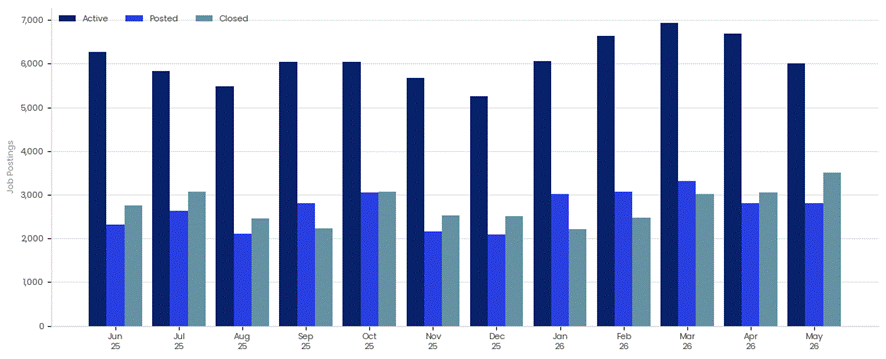
European alcoholic beverages hiring has been contracting YoY across every month of the trailing twelve months. Active postings in May 2026 stood at 6,007, down 11% YoY. That is the least negative reading in twelve months. The deceleration in the rate of contraction since March 2026 is the analytically significant development. The sector has not returned to growth, but it is contracting more slowly, and the cross-sectional signal within it is sharper than the aggregate. Heineken is running counter to the market at scale, and where it is hiring, is rewriting the geographic ranking of the sector.

The contraction is decelerating
Active postings peaked at 6,934 in March 2026, still down 32% YoY at that peak. By May 2026, the YoY decline narrowed to 11%, the smallest gap in twelve months. Through 2025, the trajectory ran consistently negative, with YoY active posting declines ranging between 27% and 31% from June through November. The improvement since then is gradual but directional. Posted volume at 2,816 in May was down 44% YoY, reflecting the prior-year period when posting activity was materially higher.
Closed postings at 3,499 in May exceeded new postings at 2,816, indicating continued drawdown of the existing active inventory. The sector is filling roles faster than it is opening them, consistent with a cautious hiring posture where existing vacancies are being cleared rather than new ones initiated. The rate at which the YoY gap is narrowing is the signal worth tracking.
Figure 1: Monthly Active, Posted & Closed Job Postings — Alcoholic Beverages, Europe, Jun 2025–May 2026
Source: GlobalData Jobs Analytics
The luxury portfolio and the beer major are moving in opposite directions
LVMH Moet Hennessy Louis Vuitton SE remains the volume leader with 874 postings in May 2026 but is down 72% YoY from 3,147 in May 2025. The scale of LVMH’s reversal is the dominant factor in the aggregate sector decline. At 31% of total sector postings, its correction pulls the headline number in one direction regardless of what the rest of the market is doing. The dynamic mirrors the Wipro effect in APAC AI hiring: a single dominant employer whose direction sets the aggregate.
Heineken’s counter-cyclical build is the structural signal. At 728 postings in May 2026, up 270% YoY from 197 postings in May 2025, Heineken has moved from a distant sixth-place employer to second only behind LVMH. Strip LVMH out and Heineken leads the sector. Its 135.6% month-on-month growth confirms this is not a seasonal blip. Pernod Ricard at 86 postings and up 62% YoY, and The Coca-Cola Co at 53 postings and up 212% YoY, add two further names building in a contracting market. Diageo, by contrast, is down 45% YoY. The spread between Heineken at +270% and LVMH at -72% is 342 percentage points.
Figure 2: Top Companies by Jobs Posted — Alcoholic Beverages, Europe, May 2026 vs May 2025
Source: GlobalData Jobs Analytics
The highest senior share across any sector
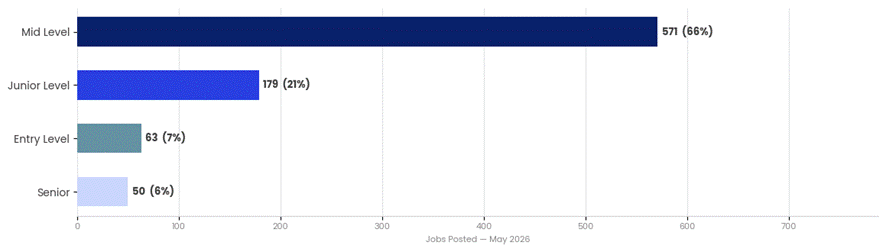
Mid-level roles account for 66% of May 2026 alcoholic beverages postings in Europe, junior for 21%, entry level for 7%, and senior for 6%. The 6% senior share is the highest observed across any sector.
Alcoholic beverages in Europe is a branded consumer goods market where senior commercial, marketing, supply chain and regulatory roles carry disproportionate strategic weight relative to volume. A senior hire in a spirits or premium beer business is a brand and channel decision, not just a headcount decision. Against a backdrop of sector-wide contraction, the maintenance of a 6% senior share signals that the companies still hiring are prioritising leadership and strategic capacity over operational volume.
Figure 3: Seniority Mix of Jobs Posted — Alcoholic Beverages, Europe, May 2026
Source: GlobalData Jobs Analytics
The Heineken effect is rewriting the European geographic map
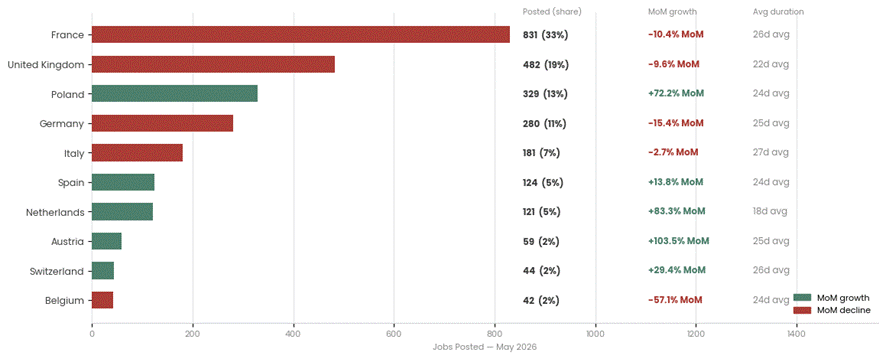
France accounts for 831 of 2,493 posted jobs in the geographic breakdown, 33% of the total, and is down 10.4% month-on-month. The United Kingdom follows at 482 postings and 19% share, down 9.6% month-on-month. Together they represent 53% of European alcoholic beverages hiring. Both are declining.
The growth story is in the markets where Heineken is building. Poland is up 72.3% month-on-month, with Heineken accounting for 266 of 329 postings. The Netherlands is up 83.3% month-on-month, with Heineken’s Dutch headquarters driving the volume. Austria is up 103.5% month-on-month. These are not broad market expansions; they are the geographic expression of a single company’s counter-cyclical hiring programme. Belgium is in the sharpest decline, down 57.1% month-on-month. Germany, the second-largest beer market in Europe, is down 15.4% month-on-month. Where Heineken is not hiring, the European map is largely contracting.
Figure 5: Jobs Posted by Geography — Alcoholic Beverages, Europe, May 2026
Source: GlobalData Jobs Analytics
Job postings lead earnings revisions by one to three months
The deceleration in YoY active posting declines, Heineken’s counter-cyclical build, Pernod Ricard’s sustained YoY growth, and the E-commerce and Health and Wellness thematic investment are not visible in brand revenue guidance, distributor volume data or quarterly earnings commentary. They surface in job postings first, and the positioning window closes before the signal reaches public disclosure. The combination of volume trajectory, company-level dispersion, seniority composition and thematic ordering produces a multi-factor signal that ranks companies differently than any aggregate screen.
The ten companies visible in this dataset are the largest European alcoholic beverages employers by posting volume. The full universe of beverage companies active across the continent is substantially wider. A systematic read of hiring intent across that complete universe, with decomposition by company and market, is what converts a data observation into a durable, repeatable factor.
Across all sectors, detailed hiring and workforce data provide an early, forward‑looking signal of where investment, capacity and risk are shifting. By monitoring changes in roles, skills and locations before they appear in financial results or analyst consensus, leaders and investors can make better decisions on where to back growth, where to scale back, and how to stay ahead of competitors. GlobalData Jobs Analytics captures point‑in‑time postings directly from company career pages, tagged by company, sector and theme. To see this in practice, request a data sample today by contacting hirendra.vikram@globaldata.com and download the white paper below to start turning complex hiring patterns into clear signals you can use in planning and investment decisions.
