


The global food and beverage industry is rapidly shifting from synthetic colour additives to natural, plant-based pigments. This transition is primarily driven by changing regulatory frameworks in the United States. State-level legislation, such as the California Food Safety Act, alongside heightened FDA scrutiny and retail-enforced ingredient bans, directly targets widely used synthetic petroleum-derived dyes (e.g., Red 40, Yellow 5, and Yellow 6). Consequently, manufacturers require scalable, clean-label natural alternatives. However, replacing synthetic dyes presents complex technical challenges. Natural pigments inherently lack thermal stability and are chemically bound to the intense sensory characteristics of their botanical sources.
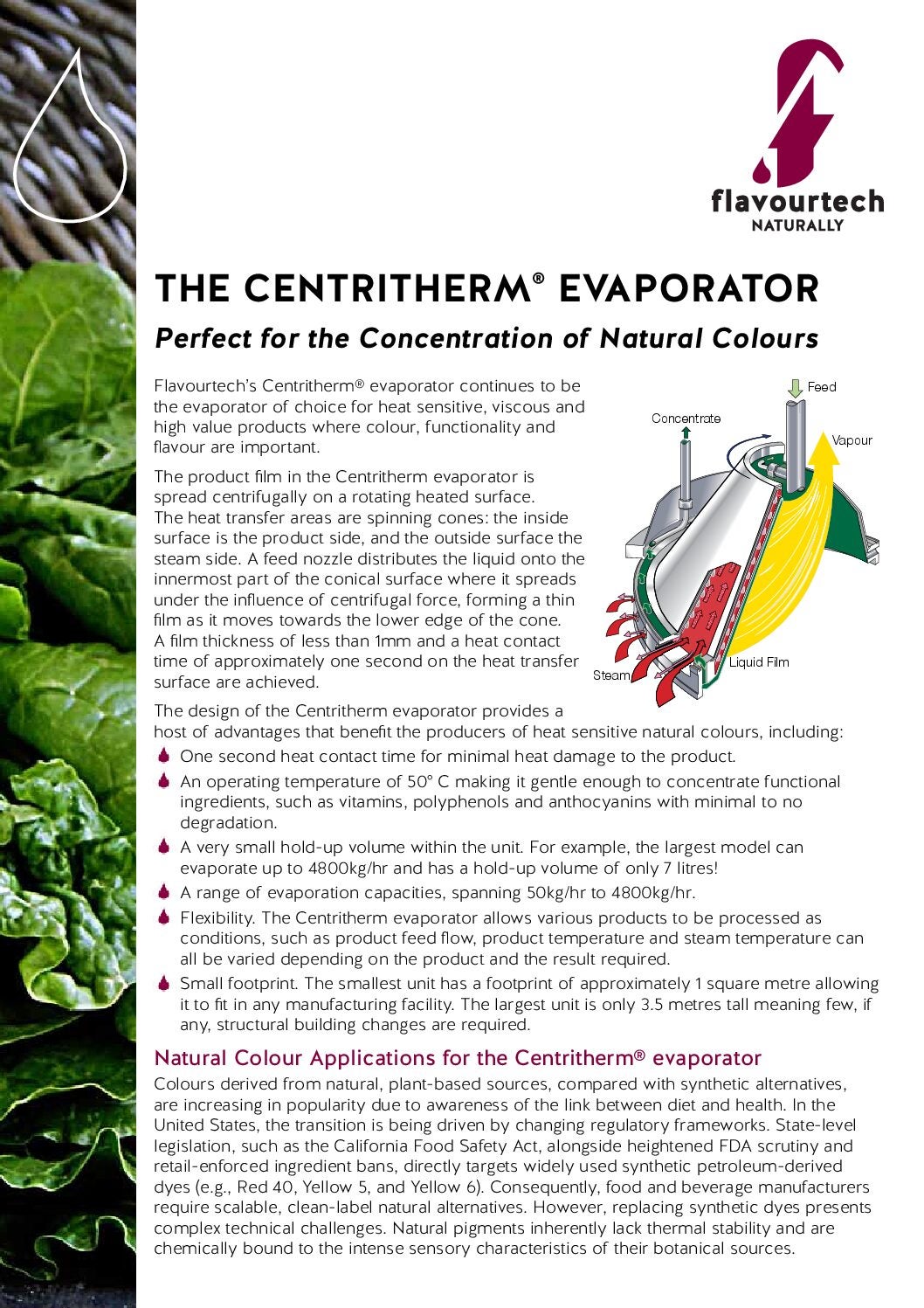
One company assisting natural colour manufacturers in solving these challenges is Australian technology company, Flavourtech. Flavourtech has been designing and manufacturing thin-film evaporation and distillation systems for over three decades. The company specialises in gentle thermal processing, flavour management, and continuous extraction technologies for the food, beverage, and pharmaceutical industries.
Its core expertise lies in designing processing systems that operate under vacuum and reduce the thermal impact on heat-sensitive materials. By minimising residence times and processing temperatures, these systems isolate and concentrate delicate botanical fractions without causing molecular degradation or structural alterations.
The Technical Challenge: Volatile Co-Extraction
Extracting pigments from botanical materials presents a major hurdle: the co-extraction of volatile organic compounds (VOCs). These volatiles carry the intense, characteristic organoleptic profiles of the source material. If left unmanaged, these residual flavours and aromas can alter the sensory profile of the final food product.
To solve this, Flavourtech utilises their flagship Spinning Cone Column (SCC) technology. The SCC is a continuous, multi-stage gas-liquid counter-current distillation column that operates under vacuum conditions. It features an alternating sequence of fixed cones and rotating cones attached to a central shaft.
Volatile Stripping Mechanics in the SCC
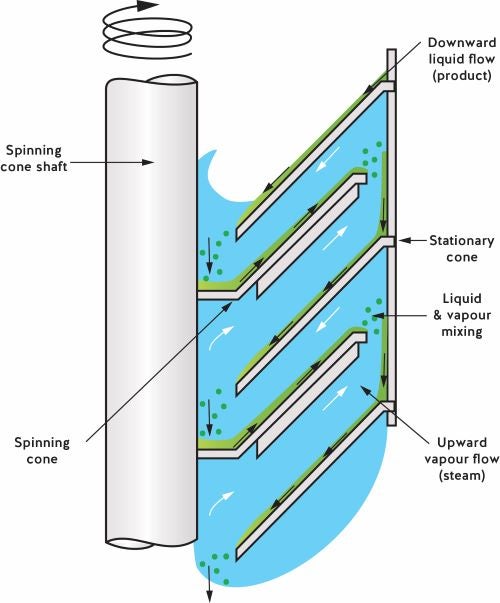
- Centrifugal Thin-Film Generation: Product feed enters the top of the column.
- Flow Path: Product flows down the first fixed cone surface.
- Film Formation: Product drops onto a rotating cone.
- Force Applied: Centrifugal force spreads it instantly.
- Thickness: It forms a 1 mm turbulent thin film.
- Low-Temperature Stripping: Vacuum steam enters the base of the column.
- Vapour Action: The steam strips the volatile VOCs from the product in a counter-current direction.
- Sensory Neutrality: Low boiling points prevent thermal degradation.
- Output: An aroma-neutral natural pigment stream results.
The SCC can process a variety of raw materials including clear liquids, purees, pulps and suspended solids-containing slurries, making it suitable for a wide range of food and beverage applications.
Concentration Mechanics
Following deodorisation with the SCC, the dilute colour fraction must be concentrated into a high-solids liquid for commercial stabilisation and logistics. Standard thermal evaporation systems rely on long residence times and high operating temperatures. These conditions trigger thermal degradation pathways in natural pigments, causing oxidation, polymerisation, and unwanted browning.
Flavourtech addresses this with their Centritherm® evaporator, a centrifugal thin-film evaporator. The evaporator consists of a series of hollow, cone-shaped stainless-steel elements rotating inside a vacuum chamber. Steam is supplied to the inside of these hollow cones.
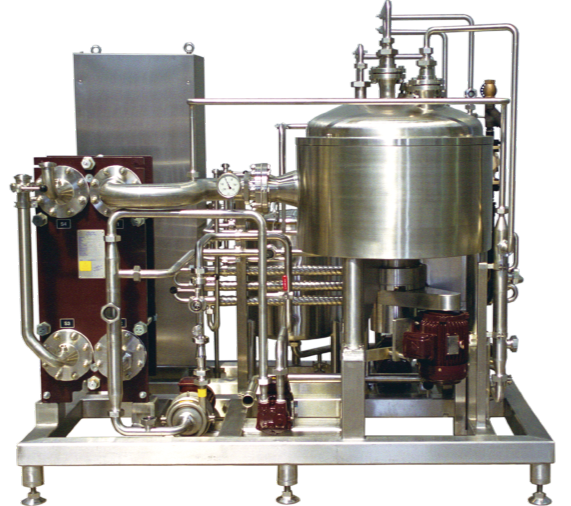
The Centritherm® evaporator comes in a variety of models to suit various throughputs. Pictured above is a smaller scale model, known as the CT-2.
Thermal Kinetics in the Centritherm evaporator
- Direct Feed: Product is applied to the rotating cone’s inner surface.
- Instant Spread: Centrifugal force flattens the liquid stream.
- Micro-Film: The resulting layer is 0.1 mm thick.
- Heat Transfer: High turbulence maximises the U-value heat coefficient and prevents burn-on.
- Flash Evaporation: Solvent vaporises instantly as it moves toward the outer edge of each cone.
- Speed: Total heat contact time is approximately one second.
- Degradation Prevention: Sub-second exposure eliminates thermal degradation risks.
- Quality Assurance: The pigment retains the natural colour hue of the raw material.
- Aroma Control: The process prevents cooked or burnt off-notes developing.
Industrial Application Examples
Example 1: Anthocyanin Red from Blood Orange
Flavourtech’s evaporation architecture allows natural colour producers to economically upcycle agricultural side-streams and waste biomass. For instance, processing juice from blood oranges yields high concentrations of anthocyanin pigments.
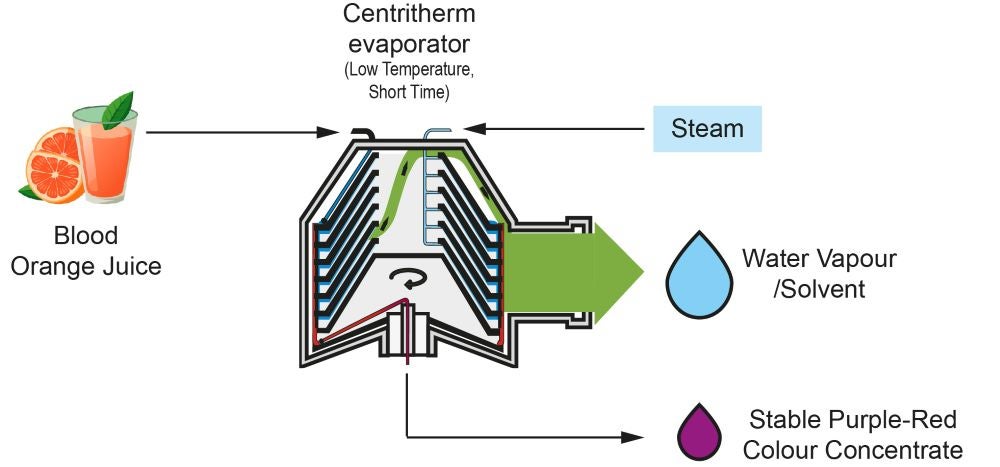
The blood orange juice is directed to the Centritherm evaporator where it is rapidly concentrated into an intense purple-red natural colouring without the generation of burnt or cooked citrus flavours. This delivers a highly functional, stable, and clean-label colourant compatible with sensitive applications like clear beverage matrices.
Example 2: Polyphenolic Brown from Spent Tea Leaves
Food manufacturers frequently require a natural, clean-label brown colourant to replace synthetic alternatives or caramel colours (which face regulatory scrutiny over 4-methylimidazole by-products). Spent tea leaves or raw black tea extracts serve as an excellent source of rich, brown polyphenolic pigments (Thearubigins and Theaflavins). However, unrefined tea extracts carry intense, bitter herbal notes and heavy astringency aromas that warp the profile of target food matrices.
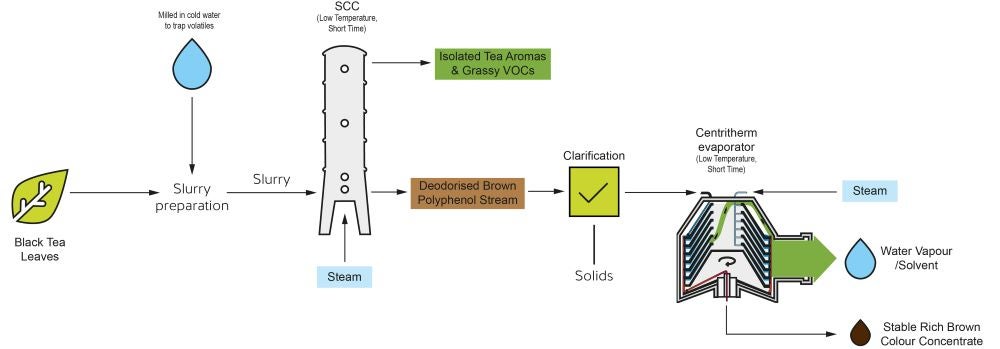
By routing the black tea extract through Flavourtech’s Spinning Cone technology, these volatile character components may be efficiently removed. The result is a product stream that exits the SCC stripped of its characteristic tea aroma and with a pure, deep-brown polyphenolic pigment. This stream may then be concentrated using the Centritherm evaporator. Because this evaporator limits heat exposure to approximately one second, the tea polyphenols are concentrated into a deep, dark-brown liquid without thermal oxidation, cream-down precipitation, or scorching. The result is a highly soluble, sensory-neutral natural brown colorant perfect for use in baked goods, sauces and iced tea beverages.
Flavourtech provides complete engineering services from initial pilot-scale validation to full factory integration. Processing efficiency, mass balance configurations, and product development may be evaluated by scheduling a trial at their facilities in Australia, USA or the Netherlands. Each pilot plant is supported by qualified and experienced technical staff who assist in designing and running trials to achieve specific project objectives and produce better quality natural colours.
To learn more, download the bulletin on the use of Flavourtech’s Centritherm evaporator for natural colours.
