

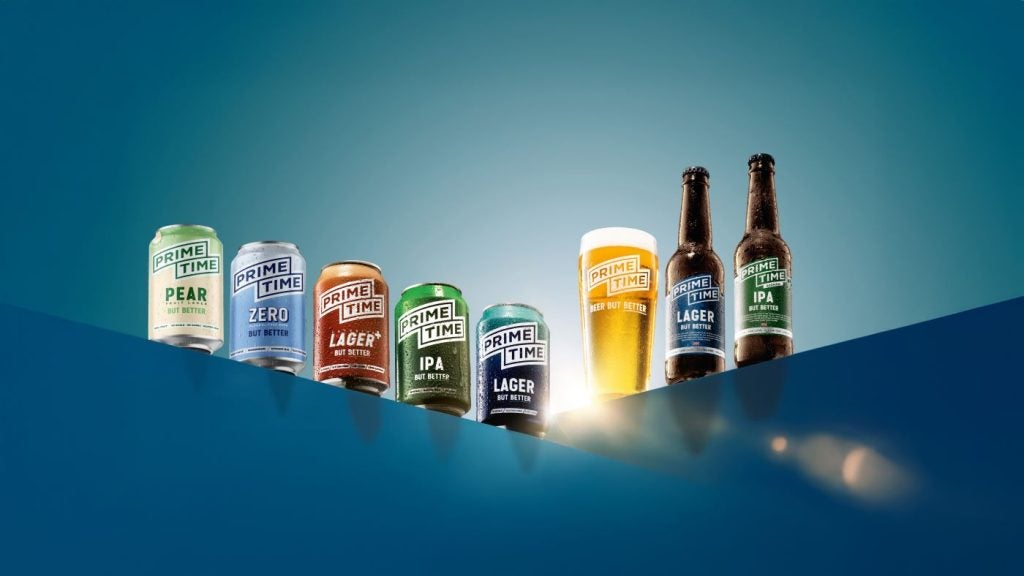
Launched five years ago by Harvey Armstrong and Sam Holmes, UK-based Prime Time is a business looking to provide ‘better-for-you’ options for beer drinkers.
Armstrong reflects the firm found trying to build a presence in the UK was “like pushing water uphill” early on but says the company is making progress and starting to see “a tidal shift” from buyers in its low-calorie and low-carb beer and growing interest in international markets.

Discover B2B Marketing That Performs
Combine business intelligence and editorial excellence to reach engaged professionals across 36 leading media platforms.
Just Drinks sat down with Armstrong, Prime Time’s CEO, to discuss the company’s plans to expand in the UK and abroad and why he says there is growing traction for beers that are “health conscious-aligned”.
Fiona Holland (FH): At the upcoming International Beer and Cider Strategies conference, you’re going to be presenting on the subject of “brewing for the modern lifestyle”. What do you mean by this?
Harvey Armstrong (HA): The overarching body of the chat is going to be talking about the shifts in consumption habits, more generally, across the global market.
We’ve got a huge macro movement on our hands and it’s looking at that high level and, more granularly, how that’s affecting the beer industry and where Prime Time is positioned to cater to this modern consumer.

There’s a lot of data and pull-outs but, ultimately, [I am] talking about this moderation movement within the beer space and people really looking for quality over quantity. They’re not necessarily, you know, pulling away from beer. They’re either drinking high quality stuff less frequently or looking to moderate.
You’ve got traditionally, very high-calorie, high-carb beers, abvs being high – it used to be much more of a popular style but I think the consumer market is moving away from that. People are so health-conscious, fitness focused… I guess, expedited by the effects of lockdown, everyone’s really sensitive to their longevity and trying to find those marginal gains across this full spectrum of life.
That’s where Prime Time comes in. It’s this better-for-you, health conscious-aligned beer but without compromise and that’s always been what Prime Time prides itself on.
FH: Is low-calorie beer still a bit of a niche in the UK and globally?
HA: I’d say it’s still a niche here in the UK but a massively growing niche. If you look at global markets, it’s not at all a niche. It’s a complete mainstream movement in that Michelob Ultra is the number one selling beer by volume in the US, which is a 4.2% abv, 95-calorie-per-can beer, which is exactly the same credentials as us, Prime Time, our lager.
Then, in Australia, again, [they are] more progressed in the beer space than we are. [In] Australia four out of the top ten beers are low-carb, low-calorie as of 2025, so it shows there is this case study for its demand and success. We’re very cognisant that it’s not quite the same market share here in the UK. Our mission as Prime Time is to pioneer and continue to pioneer that better-for-you, functional space.
It’s like every other category in the FMCG space. The development is a more health-conscious functional option
My experience has been that the first few years were pushing water uphill and really getting that consumer traction, getting bars and pubs and retailers aligned with the value proposition, was a lot harder. We’re now seeing, in the last 18 months, I’d say, a sort of tidal shift, where we’re now getting great traction in the big supermarkets and retailers because the data-led, insight-driven buyers are seeing it and they’re saying: ‘Yes, of course, this has to go this way’.
It’s like every other category in the FMCG space. The development is a more health-conscious functional option. You know, from Doritos to now these better-for-you pop chips and crisps, and from, ice cream as it was, to Halo Top, from all these, dense, heavy milks to the alternative milks. We’re just that within the beer space.
The other key thing is there’s so much pressure on the pub industry at the moment with all the taxes, rates, et cetera and they need to keep their tool shed sharp and find competitive edges. This is what Prime Time offers. It offers a beer that caters to a new form of drinker. The health conscious, the person that’s just finished their run, the gluten intolerant. We over-index massively in the female market because often it’s the bloat and the heaviness of a beer that puts off the female drinker.
FH: Is the UK your main market?
HA: The UK is where we’re trying to pioneer the better-for-you space. We are the leaders in the market and we want to continue to do that and leave our legacy in that in that space. But, given the establishment of other markets, we are getting our traction in the US. We’ve got a US importer reach out to us a number of months back, loving the name, loving the concept. We actually really outplay the flavour profiles of the current low-cal, low-carb [beers] out there. We’ve managed to nail a retail listing and some really great traction in the first month it’s been on the ground in the US, so that’s moving in an exciting way. The same with UAE prior to the issues there at the moment. Again, there was some inbound interest, never a primary focus of ours but, given what we’re doing here in the UK, we’ve got some interest in international markets who share similar demographics and understand the value proposition that we offer.
FH: Within the next 18 months, are you looking to head into any other markets?
HA: We’re in some progressed talks with the Netherlands. Again, they’ve got a really progressive light beer market, so they understand this and they’re super health conscious, great healthcare, great standard of living. They’re very much progressed in that market. That would probably be another focal point. Because obviously we’re still in our high growth stage, it’s about ensuring we do target international markets that really can understand the brand.
The US is hugely exciting. We’ve had a monstrous order off the back of getting out there, which could quite quickly squash our operations in the UK. It will be really interesting to see the difference between trying to develop a market and consumer educate here in the UK, versus playing into a market that’s already got a consumer palette and mindset for the product that we offer.
FH: Where in the US are you selling?
HA: We are launching into New York, Florida, California, and Washington, D.C. around there. There are a few areas that our partner out there is working on.
FH: Do you have any listings yet?
HA: Yes. We’ve got a pilot listing with Total Wine launching June, I believe. [Through its importer CBSE Imports, the brand will go on sale in branches in Virginia, DC and Maryland]. We’ve got a number of smaller, independent retailers out there. The traction, It’s great signs early doors. But we’re yet to really start motoring out there. This all happened the last three, four months.
FH: How do you see your presence in the US and the UAE taking shape in the next 12 to 18 months?
HA: With the UAE, again, it is a bit in sort of pause mode, which is frustrating, of course. But obviously, it’s hard to say how that’s going to ease up. With the US, we’ve got some incredibly exciting and incredibly early traction, far exceeding our forecasts and expectations.
The scale of the US is incredibly big and early signs are looking very positive but the primary mission is here as the UK. It’s pioneering the space
How that’s to play out is unknown but, if we do see the traction that we’re seeing now, there will be a [concentration] on shifting some focus and resource out there for sure. As you know, it’s a hugely established market. The scale is incredibly big and early signs are looking very positive but the primary mission is here as the UK. It’s pioneering the space.
FH: Last year, you released your first non-alcoholic beer, with added magnesium and B12. What has uptake of that product been like compared to your alcoholic beers?
HA: It’s been highly reviewed. We’re in a number of on-trade venues now, pouring really well versus competition.
The magnesium and the vitamin B12 infusion, people are super interested with it, completely get it. I think they get that funnily enough more than they get the low-calorie approach.
Especially when you’re a zero drinker… you understand what magnesium is and how it fits into that fitness, wellness routine, there’s a really nice connection there. We’re not in any major retail with it yet, so it’s hard to see the uptake there but on the on-trade we know that we’ve taken competitors off the tap.
FH: Are UK consumers looking for more functionality when they choose a non-alc beer compared to a few years ago?
HA: Absolutely. If you see the movement in soft drinks, people are making those choices there to drink fully functional soft drinks versus the prior Cokes and Fantas, etc.. It’s the same mindset shifts into the beer consumption space. Actually, some of our competitors are now moving into functional space. We’ve seen BrewDog do Mello, infused with magnesium, funnily enough.
FH: Do you plan to expand your line of non-alc beers?
HA: We’re considering it. An interesting finding is from the Spanish market, in fact, which has actually really progressed in zero drinking. I think it’s the highest percentage of big consumers that drink zero. It’s plus 10%.
I guess, as the market matures, people start to want variety, so, as the UK market is maturing, it’s not going to be enough to just have your lager. You’ve seen it with Lucky Saint, they’ve got an IPA, they’ve got a lager, they’ve now got a lemon [flavour] zero. With that view in mind, we’ll definitely be looking. Potentially, you know, an amber ale.
FH: Over the next 12 to 18 months, what would you say Prime Time’s main growth ambitions are?
HA: By the end of the year, we’re looking to be in four major retail channels in the UK. The focus will be nurturing those and scaling with those partners. We’re proving ourselves very strongly in the London sphere but to kind of scale this nationally with the right partners. We’re at the precipice of working with the big national on-trade partners as well, so it’ll be a double pronged approach to honing in on good relationships with them and scaling this nationally.
FH: Would you say you’re focused equally on the on- and off-trade?
HA: I think equally. We can’t discredit the on-trade. We offer a really great product for these pubs that need, every bit of help they can get. I’m a big advocate of the pub and hospitality industry. It’s the backbone of the UK, the culture and economy.
The retail channels are great for scale, for ease of consumers getting their hands on the product, etc. They’re both moving in exciting directions for us. It’ll be a spinning plates approach.
FH: Where are the Prime Time beers made?
HA: We partner brew. It’s our recipe. We developed it over a number of years and we keep all control over that but we brew with partners here in the UK. And obviously that’s us tapping into this unused capacity across these breweries, which I think is supporting the market and more of a scalable approach for us as a high-growth disruptor.
FH: You last did a fundraise in 2024. Are you looking to raise more money in the future?
HA: We’ll do one final round, moving towards cash positive. We are gearing up for that in the early part of next year.
FH: How much you want to raise and what will you need that money for?
HA: I think we’ll be looking for sort of £3-5m ($4-6.7m) and it’ll be to continue expansion, capitalise on these new-found markets and reach short terminal velocity and economies of scale. It’s really to step jump us to that next stage.
FH: What is the investment landscape like for challenger brands in beer?
HA: It’s definitely more sensitive than it was in prior years. What it does do is it applies pressure on the big brewers and the more established players to start to think about how they can future-proof their portfolios, start to work closer with the likes of us to make sure they’re catering to the current shifts.
You’re seeing that with huge acquisitions and in the space, you know, the Poppis and the Huels… Grüns just went to Unilever for $1.2bn [the price was undisclosed]. These are big conglomerates. They’re traditional, and they’re trying to remain relevant and that’s where we come in. So, yes, it’s a tough investment market but I think there’s a huge light at the end of the tunnel.
Executives from Asahi, Damm and Mahou San Miguel are to feature at Just Drinks’ annual International Beer Strategies event, which kicks off in Barcelona at the end of the month.
The two-day conference, in partnership with our sister events business Arena International, is taking place this year at the InterContinental Barcelona on 28 to 30 April.


