

The founders of Quarter Proof are trying again, five years after they launched the “mid-strength” spirits business – and believe their new concept will be at the forefront of a new category in the sector.
Demi is a new, 20% abv, spirits brand developed by childhood friends Fabian Clark and Rohan Radhakrishnan, with the UK company launching its first products, alternatives to vodka and Tequila, in the US.
Go deeper with GlobalData


Discover B2B Marketing That Performs
Combine business intelligence and editorial excellence to reach engaged professionals across 36 leading media platforms.
Just Drinks sat down with Radhakrishnan in central London to hear the rationale for the new venture, Demi’s decision to focus initially on the US, its target consumers and how the company hopes to distinguish itself as larger drinks businesses enter the emerging product area – including Diageo.
Dean Best (DB): Is there a genuine consumer need for a 20% abv spirit?
Rohan Radhakrishnan (RR): We’ve seen non-alcoholic alternatives in drinks, spirits, beer and wine explode and become a mainstay but, even with an abundance of product launches and the big players backing the category, the vast majority of consumers are still alcohol drinkers.
What does that tell us? The majority want to drink in a more moderate way and they’re using non-alcoholic products to help. At the other end of the market, the big spirit brand owners and wine categories are declining in consumption. We’ve spent four or five years in the middle, waiting for this moment when people wake up to the idea that they want to drink in a more measured way.

What are the best ways to do that? Is it one full-strength drink? Is it one non-alcoholic drink, then one full-strength drink – zebra-striping – or do we land on certain occasions with something already crafted for that behaviour?
Do I believe there’s a need? One hundred per cent. I think our biggest challenge is we were the first to launch a spirits range under our previous brand, Quarter Proof. We were running around London with a bag full of 12% gin and bartenders thought we were crazy. Five years later, we’ve seen Diageo come into the category. Is that justification for our thesis? There are probably a variety of reasons but we know, whether it’s beer, wine or spirits, there’s going to be a lot of activity in this middle space. We don’t see a complete U-turn in consumption.
DB: Explain the steps from Quarter Proof to now.
RR: We created a brand. The name itself, Quarter, was the first iteration. We were at 12% abv and the name was very educational and direct because we needed people to understand what the product was straight away. It was a quarter gin, a quarter Tequila and so on.
It then became Quarter Proof, which was a very modern-looking brand. We tried to play into the idea that, if people wanted to be healthier with their consumption, we should position ourselves as a brand with more a health and wellbeing ethos, serving someone who was looking to moderate.
We felt we were always going to be limited by the potential of the Quarter Proof brand
Although we built up 1,000 distribution points and launched in other markets, we felt we were always going to be limited by the brand’s potential.
There’s a romance to the booze market. Drinks brands are built on great stories and leaning into a moment. Booze is still booze, whether you’re trying to be healthy or not. You can’t make booze healthy, so we decided to look at it again.
We worked with an agency in California, which is our big focus, to ask whether Quarter Proof was ready for the US market and whether the communications worked. The conclusion was the name was too functional and too cold. Crucially, we also had to change the abv from 12% to 15% to be classified under a spirit category. The Quarter naming and the product truth no longer aligned.
We looked at what we knew from the market’s development. We were landing on a mid-strength positioning. We came together and said: “All these different brands are emerging in this new space – it’s not no- or low-alcohol but they’re using different names, like ‘light’ and ‘low’. Let’s clean it up and call it ‘mid’ because whether it’s beer, wine or spirits, it’s roughly in the middle.” Then we said: “If we’re going to be a mid-strength spirit brand, let’s sit at mid-strength, which is 20%.” We built the brand around that, with Demi meaning half.
Quarter Proof is still available to purchase in this market but we’ll transition it over. We’ve rebuilt all the liquids from scratch.
DB: Who is the target consumer?
RR: With the first brand, we thought we were targeting a younger audience. What we know from the data is they’re not really at a purchasing age or have the spending power or interest to lean into craft, independent brands doing these things. We’ve completely flipped that.
With the new brand, we’re looking at people aged 35 to 55 and older. A lot of our direct-to-consumer customers are 55 or older. They’re ritualistic spirit drinkers. They’ve had a gin and tonic at the end of the day most days and they’re swapping to something mid-strength because it’s seamless for them to cut down. They haven’t had a great experience with non-alcoholic products. That customer group have the spending capacity and the power to try new things. That’s where we got it wrong initially and we’re seeing the results of the change now.
DB: The products are in the US, which is the first market.
RR: We sell direct to consumer and then retail will be Whole Foods and Total Wine. They’re existing listings with Quarter Proof that we’re transitioning over.
DB: Are you picking up any tiredness around zebra-striping?
RR: We refer to it as “coasting”, which is the trend of drinking just mid-strength throughout an event. I may be cynical and unfair but I think it was probably an agenda pushed by some of the bigger companies to ensure that, if you’re not drinking their alcoholic drink, you’re drinking their non-alcoholic drink.
I’m yet to feel that people, even when we speak to operators we work with, are sitting there saying “Can I have the non-alcoholic one? Can I have the alcoholic one?” I think that’s far-fetched.
We worked with Caprice Holdings on a new menu split into three: 30 cocktails, with ten full-strength, ten mid-strength and ten non-alcoholic cocktails. They were all versions of the same serves and we launched across London, Manchester, Dubai and Miami. The results were unbelievable. Mid-strength almost outsold full-strength and added 33% to total cocktail sales year on year. The mid-strength version of the same cocktail sold four times as much as the non-alcoholic one.
That was the best example we’ve had of giving all three categories equal weight. If consumers know there’s a middle-ground option, how often would they lean towards it? In cocktails, if people want to have two or three drinks for the social occasion, they can leave having had half the alcohol while still getting the flavour and ritual.
DB: Alongside direct-to-consumer and the Whole Foods and Total Wine listings, do you have any presence in the on-premise?
RR: In the US, it’ll be select ‘halo’ accounts to begin with. It’s a different strategy altogether and takes a lot of manpower.
DB: So, for the next 12 months in the US, you’ll be nurturing those existing off-premise listings?
RR: Yes and direct-to-consumer. We’ve identified those as the best channels to nurture and grow with the new brand. We committed to that, which has meant that relationships here have had to be put on pause for a year. We were in national retail [with Quarter Proof] but you’ve got to be calculated. We’ll bring [Demi] back to the UK at the end of next year. Quarter Proof will continue to sell in a lot of places until then.
DB: When you approach retailers, what do you think their reaction will be to the mid-strength concept? They’ll be exposed to it through Diageo but it’s still new.
RR: We’ve always felt the best place for us is alongside full-strength brands because we’re targeting regular alcohol drinkers. In the US and the UK, there are dedicated spaces for non-alcoholic products. If you’re a non-alcoholic drinker, you go to that space looking for non-alcoholic brands. You’re not looking for something that happens to be 20% abv because your mindset is already that you want something without alcohol.
The retailers we’ve worked with – Sainsbury’s, Whole Foods in the UK and the US – have shown us that if you have a shelf of ten gins, you need your blockbuster gins but there will always be two or three places for something new. Why wouldn’t one of those be replaced by this new category, so you can open up a whole new consumer and occasion?
It offers incremental value to retailers because it’s a whole new way of drinking
Some retailers here have told us they see it becoming a dedicated space like non-alcoholic, housing wines, beers and spirits together under “mid-strength”. I think the category is where non-alcoholic was in 2020. The retail set-up for non-alcoholic you see now is where we see mid-strength going and that will become a dedicated area. It offers incremental value to retailers because it’s a whole new way of drinking.
DB: Which Demi products are on sale at Whole Foods in the US at the moment?
RR: We launched with our vodka alternative, and we’re also about to launch our Tequila alternative. With the Tequila, we’ve added green and pink peppercorn, so it has a bit of heat.
The whole positioning of the brand is the antithesis of what we were with Quarter Proof. The brand is built on mid-century, golden-age cocktail culture – think Mad Men, think three-Martini lunches. We want to focus on that. You can still enjoy those old rituals that have long left us but you can have three amazing mid-strength Martinis.
We’re trying to make it fun. By nature, this is a new category and we don’t talk about moderation. People don’t want to be talked to about moderation.
DB: What about pricing?
RR: The vodka will be $27 and the Tequila $31. We’d priced all three spirits under Quarter Proof the same but we’ve acknowledged we need to be more sensitive to each category. Vodka is a cheaper category. We’ve always said we want to sit between a premium, full-strength spirit and anything considered mass-market. Naturally, we can’t compete with Tito’s or Casamigos at this level but we acknowledge that at 20% we shouldn’t be priced as much as a premium full-strength spirit. That’s our positioning.
DB: The UK will be the next market at the end of next year. Is it too early to ask where you might be looking further afield?
RR: There’s so much to do in the US. We always have interest from markets that don’t have anything like this, such as Japan and India. What we’ve learnt is that, as a brand, you need to be ready for export and have a toolkit that a distributor can pick up and implement. If you don’t have brand awareness for a product or a new category, you’re relying on it to sell autonomously and that’s tough.
DB: Within the US, which states are you looking at?
RR: Currently, we’re physically in California but we’ll look to expand into a second and third state next year. We’ve had interest from Texas and Chicago. We’ve been in Florida before with our previous brand and have relationships there. New York is an obvious one.
DB: What do you make of Diageo’s move?
RR: When I first saw it, I was, like, “Holy shit!” But then I was buzzing for it because this was a little idea that Fabian and I came up with in 2021.
It’s exciting and it justifies what we’ve been building, though it’ll bring its own challenges
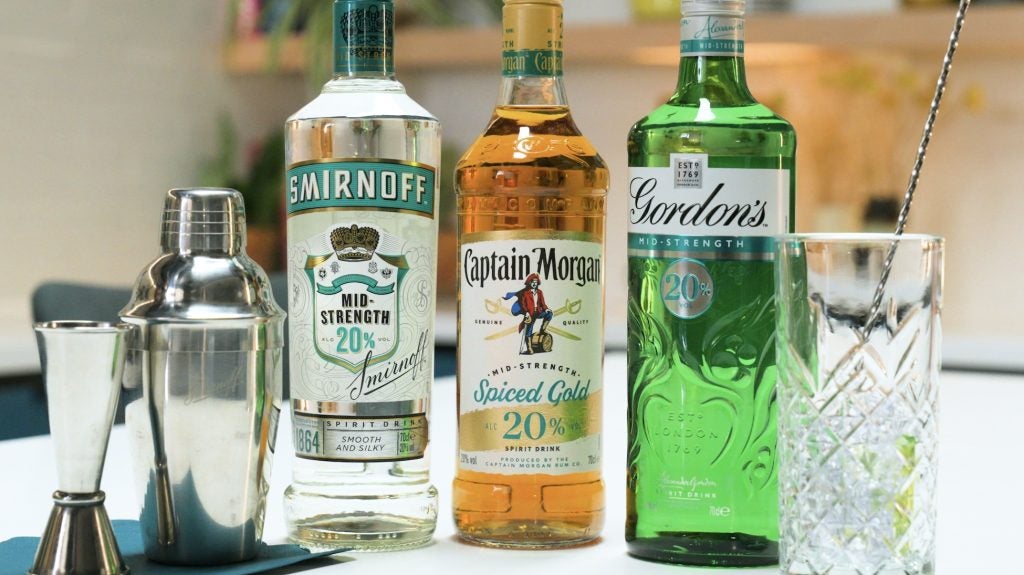
To be at a point where one of the biggest drinks companies in the world has launched three products that say “mid-strength” and use language on their label that you came up with is really awesome. It doesn’t fill me with dread. It’s exciting and it justifies what we’ve been building, though it’ll bring its own challenges.
It’ll be interesting to see how consumers take to it. What we’d always say – and I’m sure it’s the answer you were expecting – is the more marketing that’s spent on non-alcoholic drinks, whether that’s Peroni 0.0 or Heineken 0.0, the more people buy a Lucky Saint, because people are always going to be drawn to independent craft and great stories and long may that continue.
DB: But we’ve seen in low- and no-alcohol beer some independents fall by the wayside, or at least had their listings reduced, as more of the big brewers have moved into it.
RR: Our one advantage is the brand. We can have superior products as well but brand, tone of voice and an energy they can’t really tap into are where the independent brands that carry through will win.
I don’t know what you think but how does a Captain Morgan or Gordon’s drinker feel about Diageo, after spinning a different story for centuries, now saying, “Why don’t you try this at mid-strength?” Does it feel like a lesser version of what it is?
DB: Do you expect more of the bigger distillers to come into the category?
RR: We’ve already seen it. Who came in the other day? Portofino? One hundred per cent, we’ll see more of them and we’d love all of them to have a mid-strength variant and talk about it as a category.
DB: How would you compete if more of the big distillers launched mid-strength products?
RR: Brand, marketing and cultural relevance. We target women, parents with young children, we’re targeting people that love food and drink and want to understand and indulge in craft brands.
Are those people the same customers who’ll be drawn to the marketing of a Gordon’s 20%? I assume our advantage is that we can do things they can’t. We want to launch lots of cool things that I probably can’t talk about – things they definitely can never do. That’s the angle.
DB: What gives you confidence Demi can scale and gain traction?
RR: Our advantage is we’re not trying to rip up the rulebook. This is still an age-old ritual: drinking vodka, Tequila, gin or whatever we make next. Young and old people understand it. We’re not asking people to do anything different: it’s the same measures and the same glassware. If you want a Martini, you can make a Demi Martini in the same way.
What gives us confidence is the adoption is seamless. Everything after that is about engaging a large enough audience with the brand story and first-class marketing and the products have to deliver. If the world wants to drink less, we’re giving them the easiest way to do it. It’s not zebra-striping or having one drink and then stopping. That’s what we’re banking on.


