

It’s taken close to 18 months, but a buyer has finally been found for Ireland’s Waterford Whisky, which went into receivership back in November 2024. The sale marks a new beginning for the distillery – and a very different Waterford business is likely to emerge in the months and years ahead.
Waterford’s sorry saga is a parable of the changing times in Irish whiskey and in the broader spirits market. We’ll have to wait to see what the new owner, Tennessee Distilling Group (TDG), has in mind for the operation but the early signs are that pragmatism has triumphed over idealism. That may sadden hardened whisky enthusiasts but not those who find renewed employment as Waterford 2.0 takes shape.
Go deeper with GlobalData


Access deeper industry intelligence
Experience unmatched clarity with a single platform that combines unique data, AI, and human expertise.
It’s worth briefly going back over Waterford’s story. Established by Mark Reynier (who had earlier revived Bruichladdich on Islay) in a former Diageo brewery on Grattan Quay, the distillery’s mission was to refine and build on what Reynier had attempted at Bruichladdich.
That meant approaching whisky with a wine mentality, particularly in the conviction that the spirit could embody ‘terroir’ (or, as Waterford put it, ‘téireoir’), that hard-to-define French term that encompasses all the aspects of vineyard site and human endeavour. The focus on provenance and raw materials – a range of barley strains sourced from a plethora of Irish farmers – was laser-like.
Whether Waterford’s business model would have worked at another point in history we will never know. But the timing of the company’s first whisky release – in March 2020 – could hardly have been worse, coming as it did just as the first Covid-19 lockdowns were imposed. Launch events shelved, tastings hastily pivoted to online.

From that moment, Waterford was playing catch-up. A misstep in terms of US distribution – probably the single most important business decision for any Irish whiskey operation with international ambitions – and the post-Covid ‘perfect storm’ of spiralling interest rates, rising energy prices, supply chain pressures and, finally, the cost-of-living crisis – all combined to send the business into a tailspin.
Whatever its ‘terroir’ credentials, Waterford was never a craft distillery in terms of scale of production. The logic was that it would need all that whiskey when the brand took off; it was also a hedge – a potential source of cash flow if things went south. The trouble with the latter strategy was that, by the time it was activated, other players were doing the same thing – and at lower prices more in tune with the prevailing market conditions. Suddenly, Waterford was the wrong business model at the wrong time.
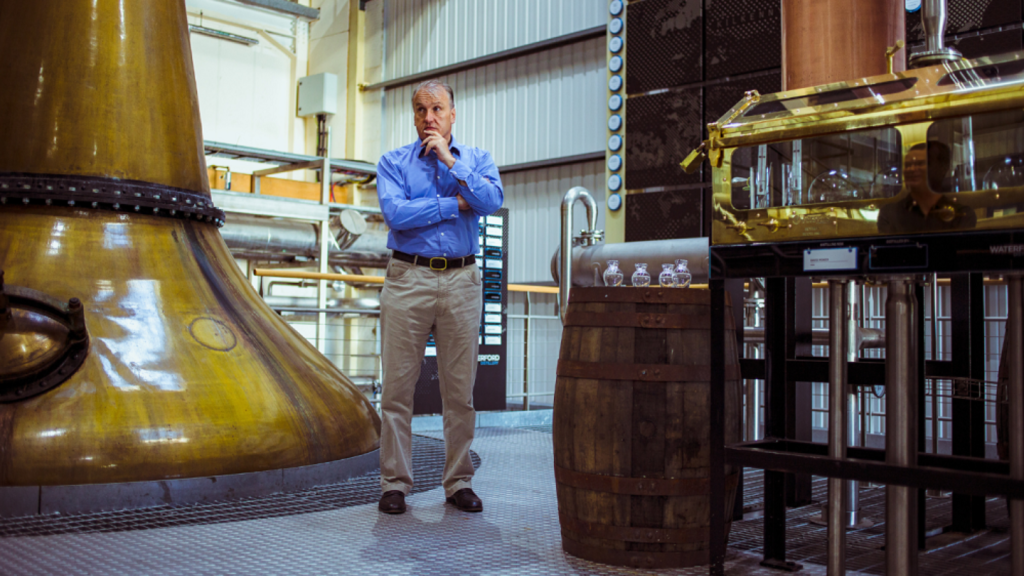
Anyone with any doubts about that need only look at the structure of the TDG deal. The American company has paid a reported sum in the region of €6m ($6.9m) to buy the distillery, the Waterford brand portfolio and all associated intellectual property. Receivers Mark Degnan and Darryl McKenna from Interpath describe this as a sale of Waterford’s “core assets” but there’s a glaring omission: the distillery’s stocks of maturing whiskey.
Back in 2022, the production value of those stocks was around €40m but, today, the retail value is more like €100m. Clearly, TDG wouldn’t have had to pay anything like that much but any agreed sum would have increased the cost of the deal by several multiples. And where, in today’s market, would the company sell all that whiskey?
Usually, when a distillery changes hands, the whisky stocks are a huge focus. What’s the age profile? What’s the value? Not in these times. TDG, it appears, would rather walk away from Waterford’s maturing whiskey, for all its zeitgeisty talk of terroir and micro-provenance.
Instead, according to a report in the Waterford News & Star, TDG will take things slowly, cleaning the place up and establishing some sort of retail operation before phasing production back in over the next year or so. When distillation does recommence, it won’t just be Waterford spirit running off the stills: in the same vein as TDG’s third-party operations in the US, contract distilling will be part of the plant’s new chapter.
The new whiskies bottled as Waterford will be, we’re told, “more approachable” and cheaper, underpinning a philosophy that favours greater simplicity – reflecting the criticism levelled at Waterford (and Bruichladdich before it) that its offer was too complex, confusing consumers who didn’t understand what the distillery’s core expression was.
And those Waterford stocks? There are reportedly close to 60,000 casks, or the equivalent of just over 14m bottles and they’ve become the focus of a new business established by Interpath’s Degnan and McKenna, Prestige Casks. The idea is to sell them to businesses as mature (or at least partially mature) whiskeys ready for bottling when market conditions permit.
Prestige Casks is also offering stocks from another failed Irish whiskey distillery, Powerscourt in Enniskerry, County Wicklow, which appointed Interpath as receiver last summer.
Most of Powerscourt’s assets were sold to US investment firm Altiva Management in January. This time, the deal did include a large proportion of Powerscourt’s maturing whiskey but 10,000 or so surplus Powerscourt casks have ended up with Prestige Casks, including some old stock from the Cooley distillery laid down in the early 2000s.
The stories of Waterford and Powerscourt – rather like the stills that have fallen silent across Ireland in recent times – constitute a jolting wake-up call for an industry that, for the past generation, could do no wrong. Irish whiskey’s woes, I’m sure, are cyclical rather than structural but, in the short term, and for start-ups struggling to stay afloat, that’s of little comfort.
Waterford’s story is far from over. As a fresh chapter beckons under new ownership – and, I suspect, with a very different ethos to the past – the whiskies created in the Reynier era will also one day be bottled and enjoyed but none of them will feature the name ‘Waterford’ on the label. In today’s whisk(e)y market, hard-nosed practicality is trumping romanticism. It was ever thus…


