

Tilray Brands’ move to buy parts of UK brewer BrewDog has had a mixed reception.
The North American brewer and cannabis group initially acquired BrewDog assets in the UK and Ireland in a pre-pack administration deal.

Discover B2B Marketing That Performs
Combine business intelligence and editorial excellence to reach engaged professionals across 36 leading media platforms.
Tilray’s share price fell after the news was announced, suggesting some investor concern but some industry watchers equally expressed positive views about the transaction.
Since then, the company has snapped up parts of BrewDog’s operations in Australia and the US.
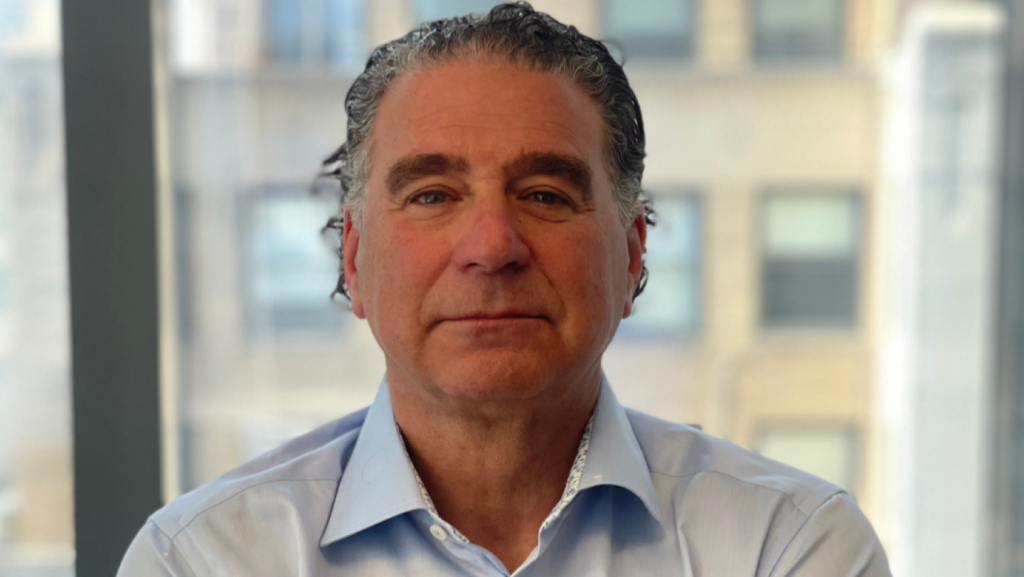
Irwin Simon, the CEO of Tilray Brands, is confident the deals can offer the company an array of opportunities for growth but is not naive about the work that lies ahead.
First step – stabilisation
In the short-term, Simon is focusing most on steadying the ship.
“We need to put stability in place,” Simon tells Just Drinks. “You’ve got a company that is going to stabilise the brand, stabilise the brewpubs, stabilise the employees and stabilise their partners out there.
“At the same time, we’ve really got to run the business. We’ve got to supply our customers. We’ve got to make sure everybody’s getting paid and, they feel, you know, justified. We’ve got to work with vendors that didn’t get paid and make sure they’re paying for continuity here. There’s a lot that’s got to happen before we move forward.”
There [were] more messages out there to the public about the founders and what’s happening than the product itself. That’s what we can’t have
BrewDog’s operating profit has declined every year since 2020 (according to the results publicly disclosed) and revenues have flattened, reaching £280.2m in 2024 versus £280.9m the previous year.
Its hospitality business has particularly struggled, with ten bars closing in the UK last year due to “continued challenges” in the sector. In January, the business announced plans to shut its spirits arm.
The story of BrewDog’s rise had its founders James Watt and Martin Dickie front and centre but the growth of the business was not without controversy. In 2021, the company was accused of creating a “toxic” workplace for staff.
An open letter, posted online under the name ‘Punks With Purpose’ and signed by 76 former employees, claimed BrewDog was built around a “cult of personality” of Watt and Dickie. Watt responded to the letter at the time, stating it was “so upsetting, but so important”. He added BrewDog was sorry, would not contest the letter but “listen, learn and act”.
In January 2024, it emerged the company was to stop paying some of its hospitality staff the UK’s so-called real living wage to tackle increased costs.
Watt stepped down as CEO later that year. His replacement James Arrow left under a year later. Watt’s fellow co-founder Martin Dickie announced his exit from the business in August last year.
Simon is hoping under Tilray’s ownership there can be more attention on BrewDog’s products than other topics.
“What’s important here is really to have a good team behind BrewDog,” Simon says. “It became the founders, the private equity, what was happening with it, transition with the leadership team, who was running this, etc… There [were] more messages out there to the public about the founders and what’s happening than the product itself. That’s what we can’t have.”
UK plans
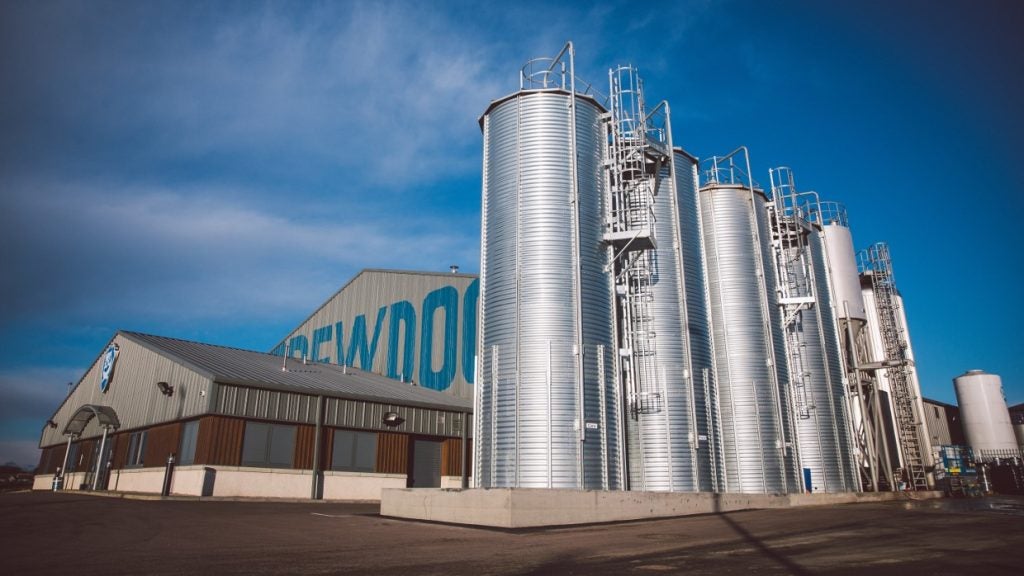
Out of the trio of deals announced, Tilray first confirmed the purchase was of a selection of BrewDog’s UK assets. The group acquired the BrewDog’s global intellectual property, its UK brewing operations and 11 bars in the UK and Ireland.
“We walked in here and invested money to buy it and we’ll invest money in the brand,” Simon says. “BrewDog has had a successful history. It is a successful brand. We have a good-sized beverage business in the US. We sell beverages in other places around the world. We have other businesses,” he says.
The chief executive also touts the fact he is no stranger to the UK, having founded US-based food and drink group Hain Celestial, which made a series of acquisitions on this side of the Atlantic. “I understand the UK,” he says.
Simon points to a need to make beer affordable again in the country. “You look at pints of beer, sometimes where they sell for $14 a pint, and that is why I think more and more consumers are not drinking beer… We [have] got to figure out ways that we can make beer fun and affordable.”
A report from The Telegraph last year suggested thousands of pubs in the UK had removed BrewDog beers from their bars over the previous two years. Simon recognises getting BrewDog’s beers back into pubs might not be an easy feat.
On-premise venues had been facing uncertainty whether BrewDog would continue running as a business, he says.
“Companies today, brewpubs today, there’s plenty of beers, there’s plenty of competition. But if there’s unknown out there, a lot of these pubs started to take things in their own hands and prepare to replace them,” Simon adds.
“We just can’t walk in there and say ‘Tilray owns us now, take us back.’ We’ve got to earn that back. How do we earn that back? That’s what is important, to go back in and say ‘Listen. Here’s where we are and here’s what we’re doing, here’s the quality of our products, here’s some of the innovation out there, here’s how we’re going to support the brand.’”
Recent reports have indicated Tilray is looking to reopen some BrewDog bars and the distillery.
Simon tells Just Drinks saw value in the distillery operation, especially given Tilray has a presence in spirits in the US. However, the company still needs to evaluate whether to reopen the business.
“I would very much like to do that but I want to make sure we can do it right, [that] it’s not a distraction right away and there’s a good plan behind it. I still don’t know the reason it closed. Was this just to save money, [or] there was not a focus on it or whatever?
“But, again, it’s there, they have good products, they have some good distribution. We have some good distribution in the brewpubs, so, with that, I very much would like to see some of their canned cocktails and that back open.”
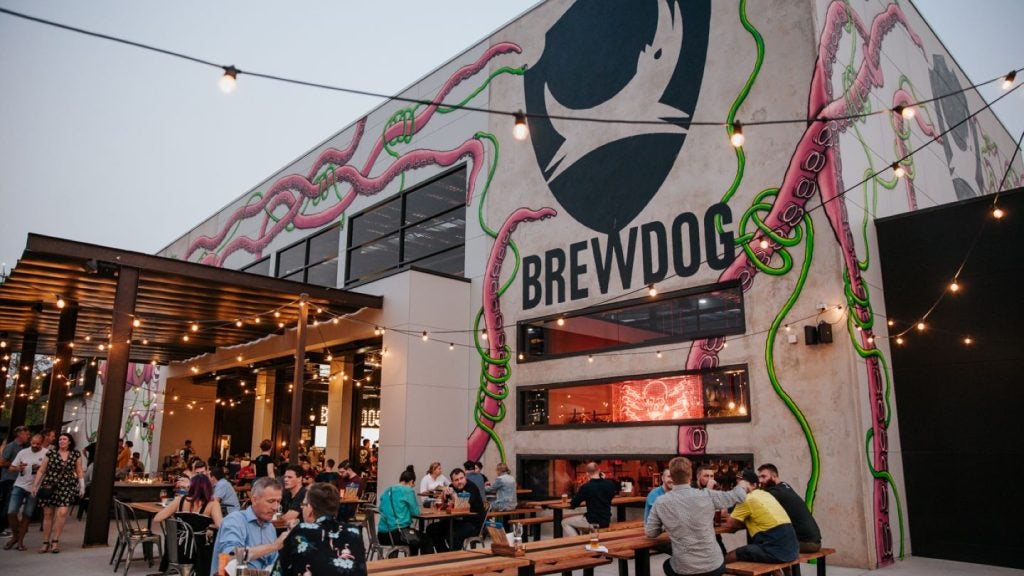
While reopening the distillery is more an idea than a concrete plan at this stage, Tilray will reopen five BrewDog bars in Aberdeen, Newcastle, Manchester and Bristol.
Global opportunities
In recent weeks, Tilray has highlighted the opportunities it sees for international expansion from the BrewDog deal, especially through its purchase of the brewer’s assets in Australia.
Simon acknowledges the country isn’t enormous but he sees value in the market: “Half the population is about 35 and under. It does a lot for us.”
In Australia, Tilray gains access to two owned bars and three licensed outlets, with the opportunity to open up more venues down the line.
The Australia move also offers “a gateway to China and Asia”, Simon says, with Tilray having access to distribution and a manufacturing facility in Australia.
He also pointed to opportunities from BrewDog’s joint venture with Asahi in Japan, which is still in the process of being formally transferred. He also said there were “opportunities in China to execute [a] similar situation”.
Tilray has also received interest from India and sees opportunities for selling non-alc and alcoholic products in the Middle East on the back of the BrewDog deal.
“The opportunities here are tremendous outside the UK, outside Ireland, outside the US and outside Australia. It’s amazing the brand recognition this brand has,” Simon adds.
Tilray plans to use BrewDog’s assets as a vehicle for expanding the international presence of some of its US craft brands.
We’re going to come in with two or three brands and focus on them and that will be it. The main focus will be BrewDog
Simon stresses the business will not use its new assets to market its entire craft portfolio but to focus on the brands it exports already. The plans centre on selling Shock Top, Sweetwater and Montauk, as these are already sold in markets such as the Caribbean and Japan.
“They are some of the brands that we export internationally today, so there is some familiarity with those brands already in that marketplace,” he explains. “We have 18 brands. We’re definitely not coming in with 18 brands. We’re going to come in with two or three brands and focus on them and that will be it. The main focus will be BrewDog.”
Some of the brands will be sold in BrewDog’s bars while Tilray may also offer them to on-premise locations that want to take on American beers or don’t want to take on a BrewDog product.
Simon also points to possibly getting the US brands into retail stores but notes it would be a small-scale push: “Ultimately, do we get them into one or two retailers? Because retailers do like imports.”
When it comes to selling BrewDog’s products in the US, the brand’s retail presence is fairly low, says Simon. The BrewDog brand is known mainly in the Midwest, where it has a production facility, bars and a hotel, as well as in Nevada, where it has a bar.
Simon says, in the first instance, the plan will not be to try and sell BrewDog’s beers across the country.
“What we’re going to do is focus on, you know, Michigan, Columbus, Indiana, Illinois, which, in that population alone, is well over 100 million people”, he says. “If I can get good distribution and good sales in three or four markets, I’ll be very happy. Instead of trying to bring it throughout the US, [which is] very expensive to do.”
The prospects for Tilray’s drinks division
Tilray has outlined plenty of opportunities from acquiring BrewDog but it is worth noting the deals come at a time when the company is facing challenges of its own within its wider drinks business.
In the 12 months to 31 May, Tilray saw the net revenue from its beverage division rise 19%, attributed to the purchase of a clutch of brands from Molson Coors last September. Gross profit from its drinks unit also increased 5% to $93m, although gross margin was down five percentage points on the year prior to 39%.
However, in the fourth quarter of that fiscal year, divisional revenue dropped 14.5%, linked to a “rationalisation” of its beer SKUs and “industry challenges”.
Tilray’s most recent set of results were published in January and cover the second quarter of its current financial year. In the three months to 30 November, net revenue for the group’s beverages division slid 21%. Gross profit slumped 37.7% and the division’s gross margin was 31% versus 40% a year ago.
There’s a lot of learnings that will help us with BrewDog and the integration of that within it. I’m seeing light at the end of the tunnel within our beverage business
In January last year, Tilray announced a cost-savings plan that included cutting hundreds of SKUs from its alcoholic drinks portfolio. Might parts of BrewDog’s portfolio put on the chopping block? Simon says it’s too soon to say but he remained upbeat the future of Tilray’s drinks division.
“You look at our volumes today, they’re down but a lot of that is three reasons: we did tremendous amount of SKU rationalisation, we also did rationalisation where we pulled out of certain regions and the category is down right now,” he says. “With that, we have learned a lot over the last four or five years and have become more cost-efficient. We closed three facilities.
“There’s a lot of learnings that will help us with BrewDog and the integration of that within it. I’m seeing light at the end of the tunnel within our beverage business.”
Despite the pressures that have faced the wider beer industry and its own business, BrewDog was an opportunity Tilray could not let pass, Simon reflects.
“You’ve got to act upon it when these opportunities come about… It’s called risk and reward and I’m a risk taker that expects rewards.”


